


Hormuz tensions rise as US-Iran standoff deepens
Iran's military said on Wednesday that several oil tankers and a liquefied natural gas (LNG) carrier had caught fire after striking naval mines in waters east of the Strait of Hormuz and off its southern coast.
In separate statements, the navy of Iran's Army and the Islamic Revolutionary Guard Corps (IRGC) Navy said the vessels had violated Iranian regulations and switched off their identification, navigation or GPS systems before entering restricted waters. The IRGC Navy said two oil tankers and an LNG carrier had exploded and caught fire after hitting naval mines.
The navy of Iran's Army warned that vessel operators and owners would be held responsible for the consequences of violating Iranian regulations in the waterway.
The reported incidents came amid a sharp rise in attacks on vessels in the Strait of Hormuz, with the number of reported incidents reaching its highest level since the conflict began.
According to the UK Maritime Trade Operations (UKMTO), more than 30 attacks on vessels in the strait were reported in October, the first time the monthly figure had exceeded 30 since the US-Israeli-Iranian conflict broke out in February. At least 22 more incidents were reported in November as of November 22.
The escalating maritime tensions have disrupted shipping through the strategic waterway, threatening the flow of energy and other commodities vital to the global economy. Both Washington and Tehran have continued to take measures affecting vessel movements in and around the strait.
The US reimposed its naval blockade of Iranian ports in July. Earlier this month, it also announced Task Force Iron Gate to restrict the movement of weapons and sanctioned materials across Iran's land borders and the Caspian Sea.
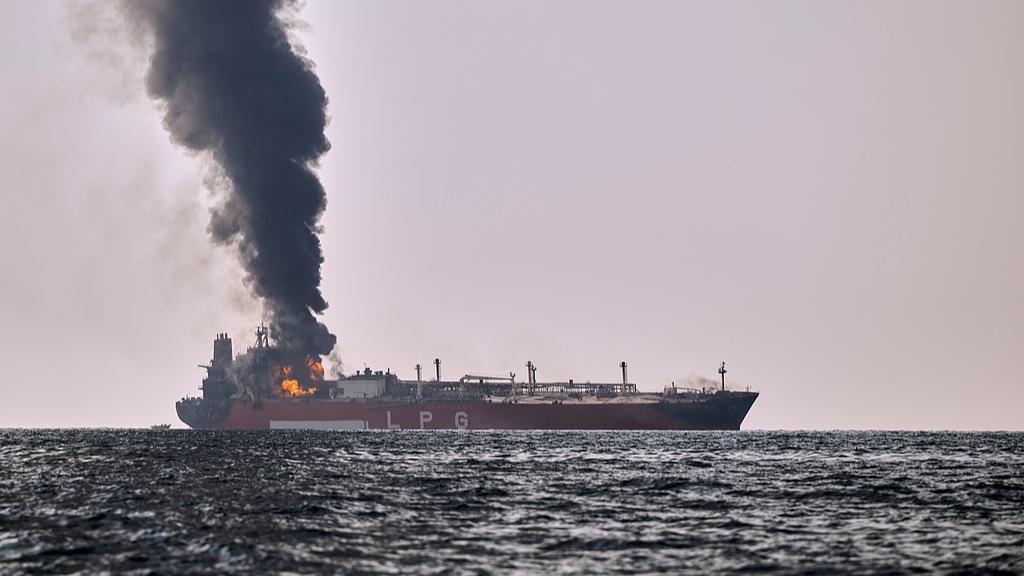
A liquefied petroleum gas tanker burns in the Strait of Hormuz off the Musandam Peninsula, Oman, November 17, 2026. (Photo: VCG)
Iran seeks to cushion economic impact
As tensions in the Strait of Hormuz continue to disrupt shipping and US restrictions add to the pressure on Iran's economy, Tehran has sought to reassure the public that it can maintain supplies and contain the economic fallout.
Iran's First Vice President Mohammad Reza Aref said on Wednesday that Tehran was not concerned about a US naval blockade as there had been a significant increase in cargo through other borders, and that the government was seeking to rein in price rises.
"The increase in the unloading and clearance of goods through non-southern borders sends the message that we are not concerned about the enemy's naval blockade," Mohammad Reza Aref said.
Strategic goods reserves were strong and supplies plentiful, he added, without giving any figures.
Tehran is facing one of its worst inflation surges in decades, driven by the nearly nine-month-old Iran war, with a particularly sharp rise in food prices.
Aref said the government was seeking to prevent increases in basic goods prices for at least three months.
Separately, Iranian President Masoud Pezeshkian said the government was seeking to direct more budget resources and energy savings towards improving living standards in poorer communities.
Consumer prices in Iran in October were 88.7% higher than a year earlier, while annual average inflation accelerated to 76.8%, Xinhua reported, citing the Statistical Centre of Iran. Food and beverage prices rose 112.6% year on year.
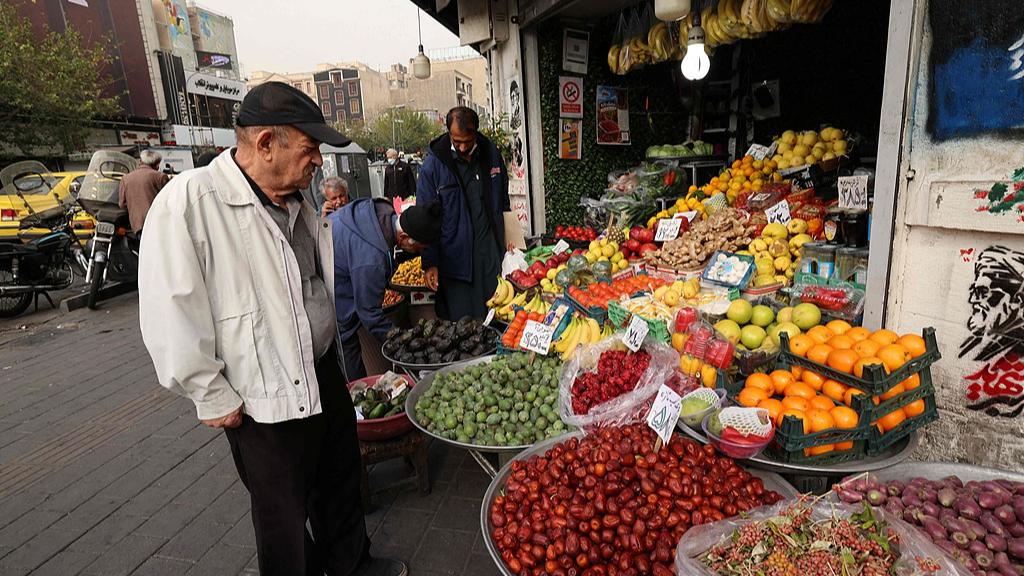
A fruit and vegetable shop in Tehran, Iran, November 16, 2026. (Photo: VCG)
US-Iran standoff likely to persist
Iran's efforts to reassure the public came as Washington stepped up economic pressure. The US Treasury Department on Monday imposed sanctions on what it described as over two dozen Iranian exchange houses, front companies and key personnel in an effort to sever Iran's global shadow banking networks.
Li Zixin, a Middle East expert at the China Institute of International Studies, said the US and Iran are now locked in an asymmetric war of attrition, with both sides seeking to exploit the other's vulnerabilities while avoiding an all-out conflict..
Against a backdrop of rising anti-war sentiment at home and dwindling ammunition stocks, Washington sees financial and economic sanctions as a relatively cost-effective option, Li said. Meanwhile, Tehran is stepping up pressure over shipping through the strait, not necessarily with the aim of imposing a total blockade, but rather to use such military actions as a deterrent, he added.
Li said he expects the standoff to persist in the coming months, with neither a full-scale war nor a substantive compromise likely. He cautioned that the biggest uncertainty is military miscalculation, noting that any casualties resulting from close encounters involving sea mines, drones or naval escorts could trigger further escalation.