


Three Japanese prefectures halt cooperation on defense booklet distribution in schools; expert warns of neo-militarist agenda entering campus
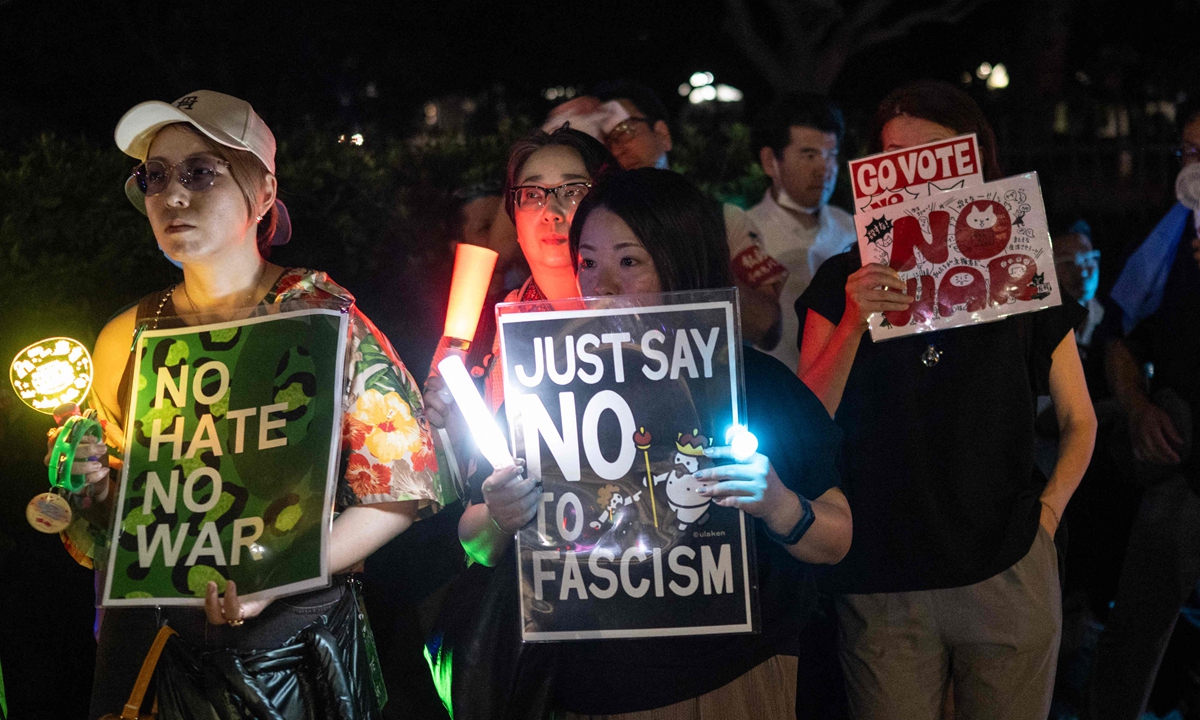
Protesters hold up signs as they listen to speakers during a rally against the current government across the street from the National Diet in Tokyo on August 19, 2026. (Photo: VCG)
Three Japanese prefectural boards of education — Aomori, Mie and Nagasaki — stopped distributing a booklet to schoolchildren that introduces the Self-Defense Forces (SDF) and security-related issues, Japanese media reported on Thursday. The distribution of the booklet in schools has already drawn opposition from teachers' unions and civil society groups across Japan. A Chinese expert warned that the initiative reflects the extension of what he described as Japan's emerging neo-militarist agenda into the education system, while opposition from Japanese educators and peace advocates reflects growing concerns within Japan over this trajectory.
Nine prefectures had distributed the booklet, titled "A guide to Japan's defense", in fiscal 2024 and 2025 to elementary schools. However, the boards of education of Aomori, Mie and Nagasaki prefectures said they will not distribute them throughout fiscal 2026, which started April 1, the Asahi Shimbun reported.
The Aomori prefectural board of education said of the booklet, "It could lead to job placement for a specific occupation," while the Mie prefectural board of education said, "It has a significant impact while also imposing a heavy burden on each school." The Nagasaki prefectural board of education said it could not confirm that the education ministry had given its approval for the distribution of the booklets at schools, the Asahi Shimbun reported.
The boards of education of Aomori, Mie and Nagasaki have not responded to the Global Times as of press time.
The Fukushima prefectural board of education, which has not decided on whether to distribute the booklets in fiscal 2026, said it is waiting for central government direction. The board said it told the Defense Ministry that it would consider cooperating if the education ministry sent a request letter, but the Defense Ministry has not responded to this condition so far this year, according to the report.
Published annually by Japan's Defense Ministry since 2021, the booklet is designed to introduce the SDF and the country's defense policies to students in the upper grades of elementary school and above.
The 2024 edition of the booklet started with the question, "Why do we need the SDF?" and answered it by saying Japan needs "deterrence" to prevent a war. Citing North Korea, Russia and China, the booklet claimed, "We cannot say the region where Japan is located is safe," the Asahi Shimbun reported.
It also explained the importance of having counterstrike capabilities, strengthening defense technology and production of equipment, securing personnel and cooperating in the Japan-US alliance, the report said.
The booklet has drawn criticism for emphasizing military power over diplomacy, portraying certain countries as threats in ways that could fuel bullying and discrimination in schools, and including material that critics say is intended to recruit children into the SDF and could run afoul of the Convention on the Rights of the Child, according to Japanese media reports.
Teachers' unions and civil society groups have called for the ministry to halt distribution of the booklet and recall copies already distributed.
"Of the nine prefectures that cooperated last time, three have now decided to stop the booklet, which creates enemy countries and introduces discrimination and division, and is not appropriate for public education," Peace Aichi, a Japanese NGO wrote on X on Thursday.
A Japanese X user said that it's wrong to instill in children from elementary school onward the idea that the countries surrounding Japan are all enemies.
The booklet emphasizes "deterrence" while downplaying the role of diplomacy. We question whether it is consistent with the Japanese Constitution and the Convention on the Rights of the Child. We believe that education that fosters peace should be protected in accordance with the principles of pacifism enshrined in the Japanese Constitution and the Convention on the Rights of the Child. Our slogan is: "Never send our students to the battlefield again," Kanai Yuko from Japan's ZENKYO (All Japan Teachers and Staffs Union) told the Global Times.
Yuko said that ZENKYO is calling for an end to the distribution of the 2026 edition of the booklet produced by Japan's Ministry of Defense, to schools. The organization will prepare written requests based on local circumstances and submit them to the heads of prefectural and municipal boards of education, as well as regional defense bureaus where possible.
"We will also work with parents and other organizations, including the New Japan Women's Association, to carry out joint campaigns," said Yuko.
Historically, Japanese militarism relied on the education system to instill militarist ideology in young people and mobilize the population for war. The latest move suggests that Japan's emerging neo-militarist agenda is extending into the education system, Lü Chao, an expert on Northeast Asian affairs at the Liaoning Academy of Social Sciences, told the Global Times.
In recent years, Japan has increasingly portrayed China, Russia and North Korea as security threats, with a particular emphasis on anti-China rhetoric, the expert said. Introducing such narratives into classrooms could shape young people's perceptions of neighboring countries, push Japanese society further to the right and cultivate public support for military expansion and a resurgence of militarism. Opposition from Japanese educators and peace advocates reflects growing concerns within Japan over this trajectory, Lü said.