


Antarctic sea ice hits record low in October: scientists
MELBOURNE, Nov. 27 (Xinhua) -- Satellite observations show Antarctic sea ice coverage fell to record daily lows in October 2026, surpassing even the extremely low extent observed in October 2023, according to the Australian Antarctic Division (AAD).
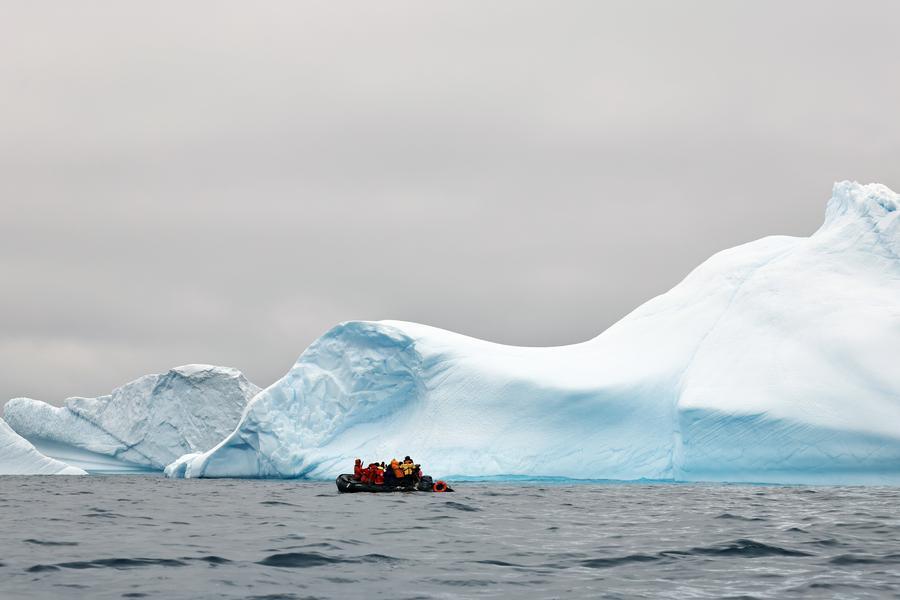
People take photos of an iceberg near the coast of Spert Island in Antarctica, Dec. 16, 2025. (Photo: Xinhua)
Antarctic sea ice extent reached its annual winter maximum of 17.72 million square kilometers on Sept. 11, the third-lowest observed since the long-term satellite record started in 1979, before shrinking by about 1.3 million square kilometers over the following four weeks, according to an AAD statement released Friday.
The rapid decline pushed the overall sea ice extent around Antarctica down to about 2.3 million square kilometers, or 12 percent, below its long-term average for mid-October, the lowest on record for that time of year, the statement said.
The decline continues a trend of rapid Antarctic sea ice loss that began in 2015, with coverage shifting abruptly to record-low levels in autumn through to winter in 2023. Poor sea ice conditions that year led to the deaths of thousands of emperor penguin chicks in Antarctica, according to the AAD.
"Unfortunately, Antarctic sea ice is now also declining at a time of year when the ocean should be freezing and the ice cover should be advancing," said AAD sea ice scientist Rob Massom, noting that the four lowest winter-maximum sea ice extents observed since 1979 had all occurred in the past four years.
Scientists said the loss of sea ice threatens Antarctic marine life, including emperor penguins that rely on stable coastal fast ice for breeding, and Antarctic krill, whose larvae shelter under and within the ice and feed on microscopic ice algae over winter.
The Antarctic sea ice decline has been broadly linked to increasing upper-ocean heat content, combined with changing wind and atmospheric temperature patterns, although scientists say its drivers and impacts remain incompletely understood.
The Australian Antarctic Program plans a voyage in 2028 to East Antarctica's marginal ice zone -- a highly dynamic area where seasonal sea ice forms and melts and biological activity is high -- to study how waves, storms, ocean heat and atmospheric processes affect sea ice and, in turn, ecosystems and the Southern Ocean's ability to absorb carbon dioxide.