


Explainer: Why is measles making a global comeback?
The World Health Organization (WHO) warned Friday that hard-won gains against measles are slipping, as vaccination gaps leave millions of children vulnerable.
According to a new WHO report, global measles deaths dropped to a historic low of 72,000 in 2025, down 91 percent from 2000. Yet nearly 10 million people still caught the virus last year and several countries have lost their elimination status, putting a fresh spotlight on why the disease is back and how to curb it.
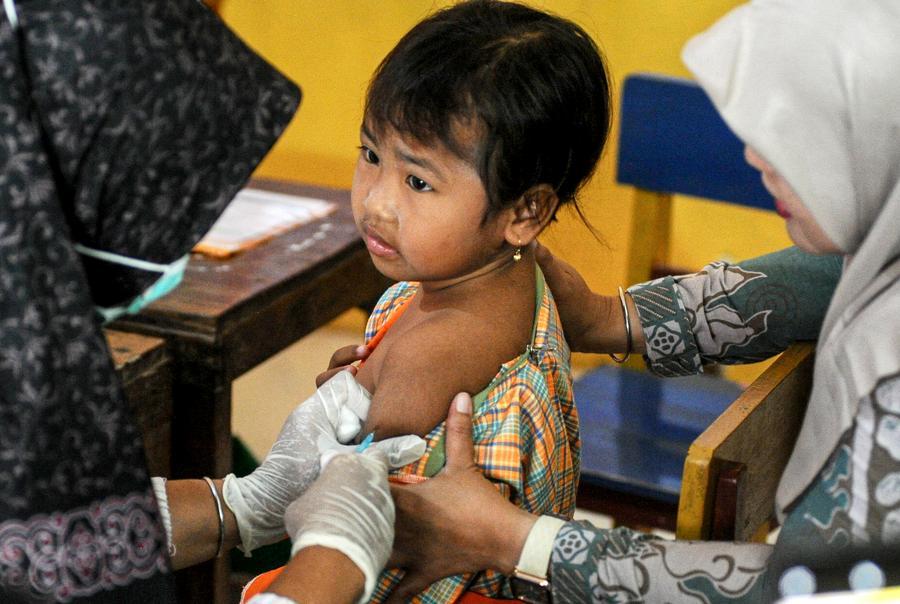
A girl receives a dose of measles vaccine in Sumenep Regency, East Java, Indonesia, on Aug. 27, 2025. (Photo: Xinhua)
WHERE DOES THE WORLD STAND
Measles is a highly contagious viral disease that spreads through the air. It mainly affects children and can cause serious complications including pneumonia, brain inflammation and even death, particularly among unvaccinated people.
The first measles vaccine was licensed in 1963, and a combined measles, mumps and rubella (MMR) vaccine became available in 1971. The WHO recommends two doses for all children by the time they reach 18 months old.
According to the WHO, vaccination efforts prevented more than 60 million deaths from the disease between 2000 and 2025.
However, the global figures mask sharp regional differences. In 2025, the Americas recorded an estimated 73,000 cases -- an eightfold increase from 2000 -- while nearly half of all global infections occurred in the WHO's South-East Asia Region.
The WHO considers measles eliminated in a country when there has been no endemic transmission for at least 12 consecutive months. That status, however, can be reversed. Canada lost its elimination status in 2025, and earlier this month, the Pan American Health Organization (PAHO) announced that Bolivia, Mexico and the United States had also lost theirs.
In January 2026, six countries in the WHO European Region -- Armenia, Austria, Azerbaijan, Spain, Britain and Uzbekistan -- were also reported to have lost the designation, based on 2024 epidemiological data.
By the end of 2025, 95 countries had been verified as having achieved or maintained measles elimination. Yet 59 countries still experienced large or disruptive outbreaks that year, including 11 previously declared measles-free, according to the WHO.
WHY IS MEASLES BACK
A major factor behind the resurgence is insufficient vaccination coverage. In 2025, only 84 percent of children worldwide received their first dose of measles vaccine, while 77 percent received the recommended second dose -- both below the 95 percent threshold needed to prevent outbreaks.
More than 29 million children were either unvaccinated or under-vaccinated against measles in 2025, according to WHO estimates. The COVID-19 pandemic further widened the gap by disrupting routine immunization services and leaving many children without scheduled shots.
In the United States, vaccine hesitancy has added to the challenge. Some Americans opt out of vaccination due to religious beliefs or personal convictions, while eroding public trust in health institutions has made it harder to sustain confidence in routine immunization, according to the U.S. Centers for Disease Control and Prevention (CDC).
A new Ipsos poll released Monday found that 58 percent of Americans believe the federal government could have prevented the country from losing its measles elimination status.
As of Nov. 12, the United States had reported 5,412 cases in 2026, compared with 2,289 in 2025. About 96 percent of the cases reported this year involved people who were unvaccinated or whose vaccination status was unknown.
Beyond vaccine hesitancy, barriers such as poverty, conflict and displacement continue to widen global disparities, with two-dose measles coverage in 2025 reaching just 57 percent in low-income countries compared with 91 percent in high-income nations, according to the WHO.
CAN THE TREND BE REVERSED
Global health leaders are sounding the alarm over the resurgence. WHO Director-General Tedros Adhanom Ghebreyesus noted Friday that while vaccines have driven measles deaths to historic lows, "measles does not forgive complacency," urging countries to ensure every child receives two doses.
Kate O'Brien, director of the WHO's Department of Immunization, Vaccines and Biologicals, called the U.S. situation a stark reminder of how quickly preventable diseases can resurface when immunization coverage slips.
"Measles is the most infectious virus known to humans," she told a press conference in Geneva. "It is back -- and the world is learning just how sick and just how dead measles can make you."
Beyond measles itself, experts warn the setbacks expose broader vulnerabilities. Jennifer Nuzzo, director of the Pandemic Center at the Brown University School of Public Health, said countries losing their elimination status signals that the world is less prepared to prevent, detect and respond to serious disease threats.
"It should be considered the canary in the coal mine for what could happen in even more severe scenarios," she said.
Still, health officials stress the trend can be reversed. PAHO Director Jarbas Barbosa described the loss of elimination status in the Americas as a serious warning, but not an irreversible one.
"We know how to prevent measles, and we know how to stop its transmission," he said, emphasizing sustained vaccination, strong surveillance and effective outbreak response.