


LANZHOU, Aug. 13 (Xinhua) -- In Dunhuang, an ancient Silk Road city in northwest China, even rain has caught the attention of Chinese President Xi Jinping.
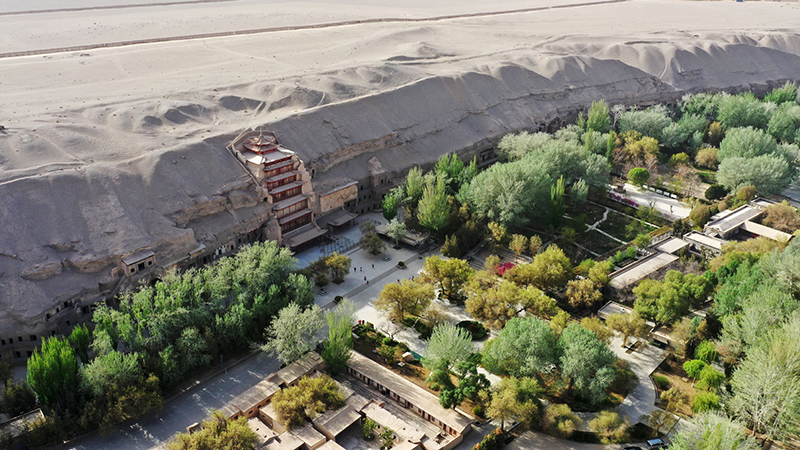
This aerial photo taken on April 25, 2023 shows the Mogao Grottoes in Dunhuang, northwest China's Gansu Province. (File photo: Xinhua)
The city is home to the Mogao Caves, a UNESCO World Heritage site dating back to the 4th century. The region's arid climate has helped preserve the murals, sculptures and a vast trove of Buddhist art in hundreds of grottoes carved into cliffs on the edge of the Gobi Desert. But increased rainfall and rising humidity, particularly in summer, can accelerate the deterioration of the fragile heritage.
During a visit to the caves in August 2019, Xi asked experts whether Dunhuang had been seeing more rain in recent years. He then turned to another challenge: how to balance growing visitor numbers with the need to protect the grottoes.
"His questions addressed the most pressing challenges facing the heritage," Fan Jinshi, honorary president of Dunhuang Academy, recalled.
Since the Mogao Caves were inscribed on the UNESCO World Heritage List in 1987, visitor numbers have risen steadily, increasing the strain on the environment inside the grottoes.
"For a World Heritage site, conservation comes first. Tourism comes second," Xi said, emphasizing that economic benefits should never take precedence over preservation.
The attention Xi has paid to Dunhuang is part of a broader commitment to protecting China's millennia-old cultural heritage. Over the years, he has repeatedly called for the protection of cultural relics, archaeological discoveries and traditional culture, while visiting heritage sites across the country to witness conservation efforts firsthand.
"Protecting and passing on our historical and cultural heritage is a responsibility to history and to the people," Xi has said.
To Xi, China's cultural legacy is not simply a glimpse into the past. It continues to shape the present and inspire the future.
For centuries, Dunhuang stood at the crossroads of the Silk Road, where merchants, monks, artists and travelers converged, bringing with them ideas, faiths and artistic traditions from across Asia.
Standing before a mural in Mogao Cave 323 depicting Zhang Qian's journey to the Western regions, Xi was drawn to a scene of openness and exchange dating back more than two millennia. The Tang Dynasty (618-907) artwork tells a story not only of diplomacy, but also of the encounters and exchanges along the Silk Road.
"Dunhuang culture reflects the cultural confidence of the Chinese nation. Only a civilization that is confident in itself can preserve its own identity while embracing, learning from and drawing on the best of other civilizations," Xi has said.
During his visit to Dunhuang, Xi called for Dunhuang Academy, which oversees the conservation and study of the Mogao Caves and other major grotto sites in the region, to become a model for World Heritage conservation.
Years later, that vision has been transformed into a comprehensive approach that combines craftsmanship, science and technology.
Inside Mogao Cave 454, conservator Yin Zhihong works with meticulous care to remove soot stains from a mural. The burning incense and candles have left the soot deeply embedded in the paint, so even the smallest mistake could cause damage.
Researchers are testing a flexible cleaning technique that uses a nanoscale sponge to lift the soot without harming the pigments. The technology is now moving from the laboratory into the caves, showing how scientific innovation is providing new tools for preserving cultural heritage.
But for Dunhuang, the focus is increasingly shifting from repairing damage to preventing it.
At the grottoes' monitoring center, a wall of screens offers a real-time picture of the caves and the environment around them. Temperature, humidity and carbon dioxide levels inside the grottoes are tracked alongside visitor numbers. Rainfall and blowing sand are monitored across hundreds of kilometers, helping conservation teams spot potential threats and act before damage occurs.
Smart cave doors turn that data into action. They automatically seal the grottoes when heavy rain approaches or sandstorms threaten, and open in fine weather to allow fresh air to circulate.
Digital technology is opening another path to protect and share the heritage. Dunhuang Academy is building high-resolution digital records that allow the murals, sculptures and manuscripts to be preserved and studied remotely, while online exhibitions allow more people to experience the heritage without adding to the pressure on the sites.
Dunhuang is part of a broader nationwide effort. Under Xi's leadership, China has increasingly prioritized the protection of cultural heritage, while promoting responsible use and minimal intervention. Years of investment, technological advances and painstaking conservation work have strengthened China's capacity to safeguard its cultural and historical legacy.
That expertise is also being introduced beyond China's borders.
In Uzbekistan's ancient city of Khiva, a major Silk Road hub, Chinese heritage experts worked with local counterparts to restore historical sites, helping bring the once-weathered city back to life.